Table of Contents
InvestorJustice.og | Regulatory Ethics Series
Many financial platforms understand a simple truth:
If consumers read the marketing and ignore the fine print, the company wins.
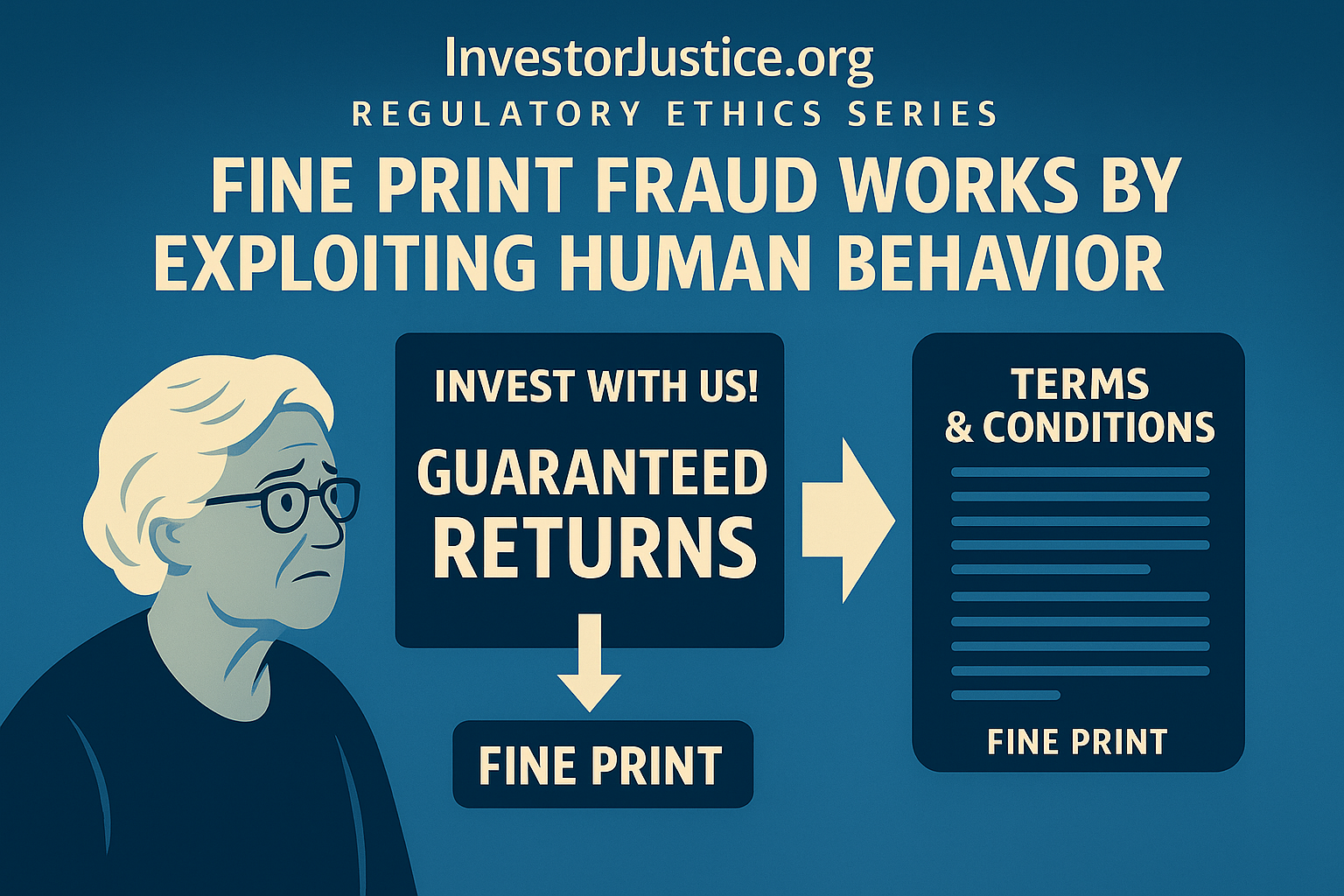
This imbalance creates a particular form of misconduct known as fine print fraud where companies push unrealistic promises up front and bury contradictions deep in the Terms of Service, disclaimers, or “risk statements” that almost no reasonable consumer will ever see.
This tactic is not an oversight.
It is a business model.
Fine Print Fraud Works by Exploiting Human Behavior
People, especially retirees, make financial decisions based on:
- clear marketing claims,
- platform dashboards,
- customer-facing features,
- and simple assurances of safety or yield.
They do not make decisions based on:
- obscure footnotes,
- legal annexes,
- offshore jurisdiction clauses,
- or 187 pages of boilerplate.
Platforms know this.
And they weaponize it.
Fine print fraud relies on a predictable pattern:
Say the attractive thing boldly, hide the real thing quietly.
When the truth is buried, deception becomes easy.
The Law Is Clear: Fine Print Cannot Cure Misrepresentation
U.S. consumer protection statutes, from the FTC Act to state UDAP laws, share a universal principle:
If the headline claim is false or misleading, no amount of fine print can make it legal.
Courts treat attempts to cure deception through buried disclaimers as:
- evidence of intent,
- proof of unfair practice, and
- aggravating misconduct.
Regulators view fine print fraud as worse than open misrepresentation because it demonstrates forethought, planning, and a deliberate attempt to limit accountability.
Sophisticated Platforms Use Legal Complexity as a Shield
Modern fintech and crypto platforms rely heavily on:
- offshore affiliates,
- contradictory jurisdictional statements,
- inconsistent ToS versions,
- “we may modify this at any time” clauses,
- retroactive policy changes.
These structural tactics serve one purpose:
To create layers of ambiguity that can be used to confuse regulators and overwhelm consumers.
By the time someone discovers the truth, often during a loss event, the damage is irreversible.
This is not a bug.
It is the architecture of exploitation.
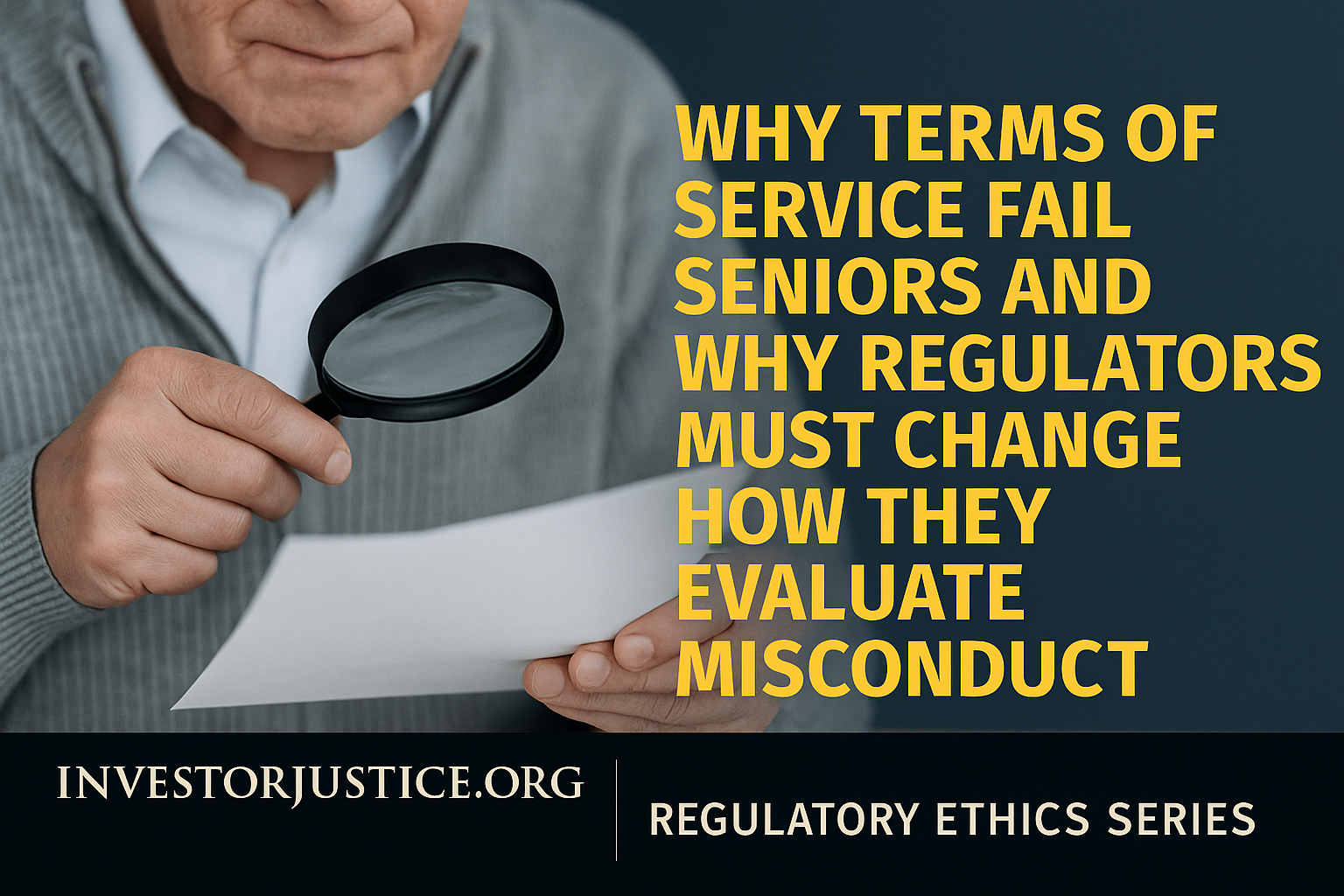
Fine Print Fraud Disproportionately Harms Retirees
Retirement-age consumers are uniquely vulnerable because they:
- rely more heavily on trust and reputation,
- have less appetite for conflict,
- cannot afford complex legal interpretation,
- are more likely to accept platform assurances at face value,
- and have limited time to recover losses.
In regulatory terms, this is a protected population.
When fine print fraud targets seniors, regulators consider it:
- an aggravated violation,
- evidence of predatory targeting,
- and a trigger for enhanced penalties.
Yet many agencies still fail to prioritize these cases, leaving retirees exposed to sophisticated deception machinery.
Platforms Use Fine Print to Shift Blame Onto Consumers
The saddest part of fine print fraud is the final insult:
victim blaming.
After misleading users with bold promises, platforms often claim:
- “It was in the Terms of Service.”
- “You agreed to all risks.”
- “You should have known this was possible.”
- “It was disclosed in Appendix 9, Section 14.3(b).”
This posture reveals the company’s actual intent:
Shift the burden of honesty onto the consumer.
But trust cannot be shifted.
And deception cannot be waived.
The Takeaway
Fine print is not a shield.
Fine print is a confession.
When a company:
- advertises unrealistic benefits,
- hides the truth in legal boilerplate,
- and blames consumers for believing the marketing,
it is not a contractual dispute, it is fraud clothed in formatting.
Regulators who ignore this pattern leave millions at risk, especially retirees who are disproportionately targeted and disproportionately harmed.