Table of Contents
InvestorJustice.org | Enforcement Ethics Series
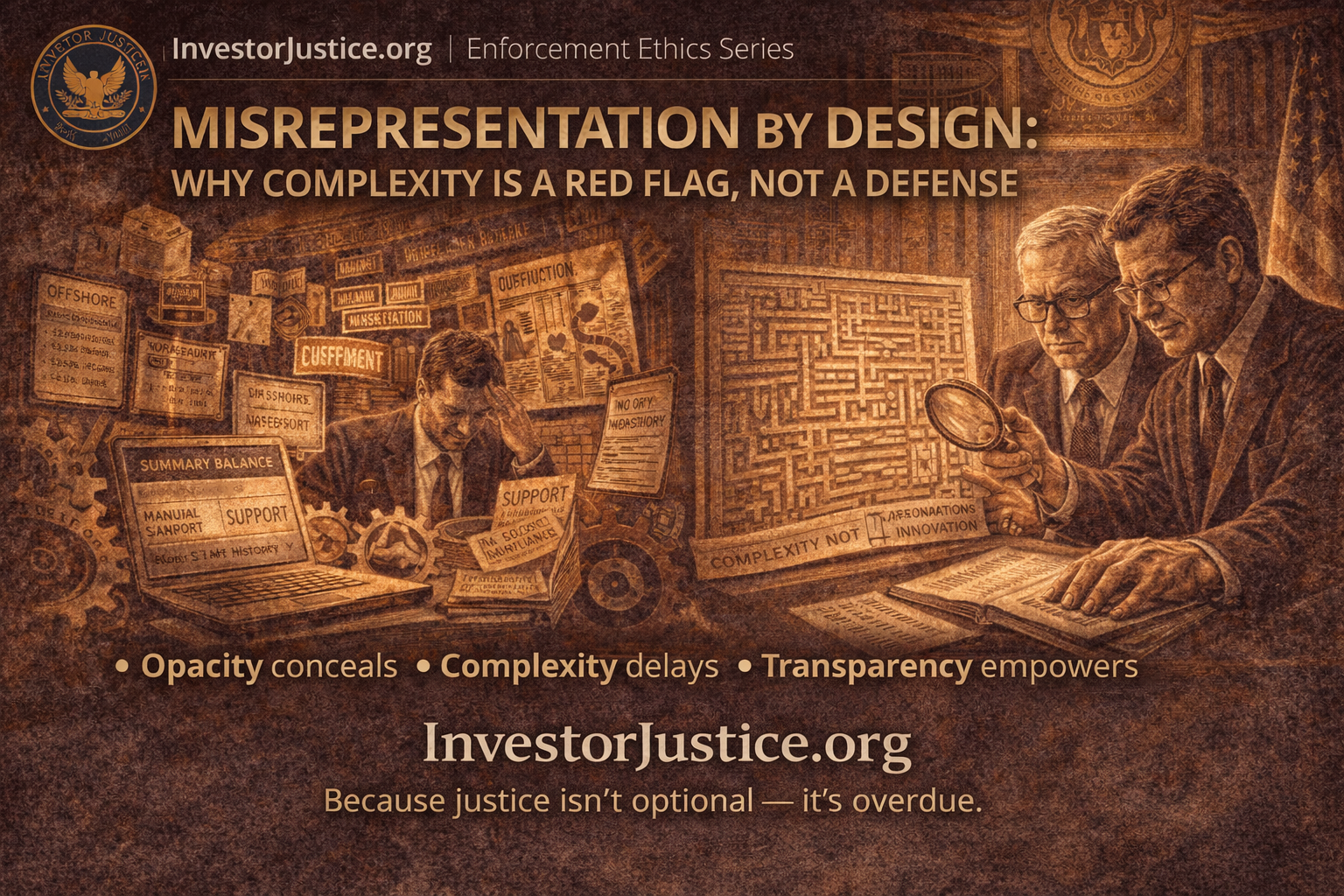
Modern financial harm no longer hides in the shadows.
It hides in plain sight, beneath sleek dashboards, offshore entities, and “innovative” user experiences designed to obscure, not inform.
And too often, regulators mistake this complexity for legitimacy, treating it as a justification instead of the red flag it truly is.
Confusion Is Not Innovation
When platforms:
- Spread operations across five jurisdictions,
- Build interfaces that show summary balances but not APR history,
- Provide “support” that never delivers records...
That’s not innovation.
That’s insulation.
It’s a design built to deflect scrutiny, not deliver clarity. And when regulators accept surface-level compliance, a license here, a registration there, they fail to recognize how architecture itself can be a tool of deception.
The difference isn’t technical, it’s intentional.
The Playbook of Delay
Sophisticated platforms know the game:
- Jurisdictional arbitrage slows investigations.
- Incomplete disclosures confuse consumers.
- API and UI complexity creates plausible deniability.
- “We’re working on it” support tickets wear down complainants.
This isn’t a bug, it’s the business model.
And the result is devastating:
- Delayed enforcement
- Overwhelmed victims
- Eroded trust
- Missed restitution windows
Which, for these companies, is not an unfortunate side effect.
It’s the entire point.
What Regulators Must Recognize
Opacity is not neutral. It’s tactical.
If a platform’s technical setup prevents a user from seeing how their money was used, where it went, or what rate applied, that’s not complexity, it’s concealment.
When firms claim their model is “too technical” for regulators to follow, that’s not a defense. It’s a confession.
- True innovation empowers.
- True compliance explains.
- True oversight demands answers, not aesthetics.
Complexity should trigger escalation not sympathy.
Why This Matters for Enforcement
Many regulators, under-resourced and overextended, default to surface-level review:
- A corporate registration.
- A customer service portal.
- A vague claim of compliance.
But this leniency, when applied to sophisticated misrepresentation, does real harm.
Especially for older investors, technical opacity isn’t just confusing, it’s disqualifying.
They can’t opt out of harm they can’t understand.
And when delay is rewarded, misrepresentation becomes the norm.
The Takeaway
Misrepresentation by design is no different than fraud by omission.
In fact, it may be worse because it hides behind credibility, speed, and UX polish.
If a platform is too complex to regulate, it is too complex to trust.
If it’s too opaque to be understood, it’s too dangerous to be allowed.
Regulators don’t need to be engineers to ask the right questions.
They just need the will to treat confusion not as an excuse but as the evidence it often is.
InvestorJustice.org
Because confusion is not a compliance strategy.