Table of Contents
InvestorJustice.org | Financial Transparency Series
The Trust Recession
Trust is the most fragile currency in finance and the only one that cannot be printed back into existence.
Over the past decade, a cascade of scandals, from crypto collapses to fintech frauds, has eroded public confidence not only in specific firms but in the very idea that modern finance can be both digital and accountable.
When every crisis begins with “we didn’t know” or “the data was unavailable,” the problem isn’t the product. It’s the system.
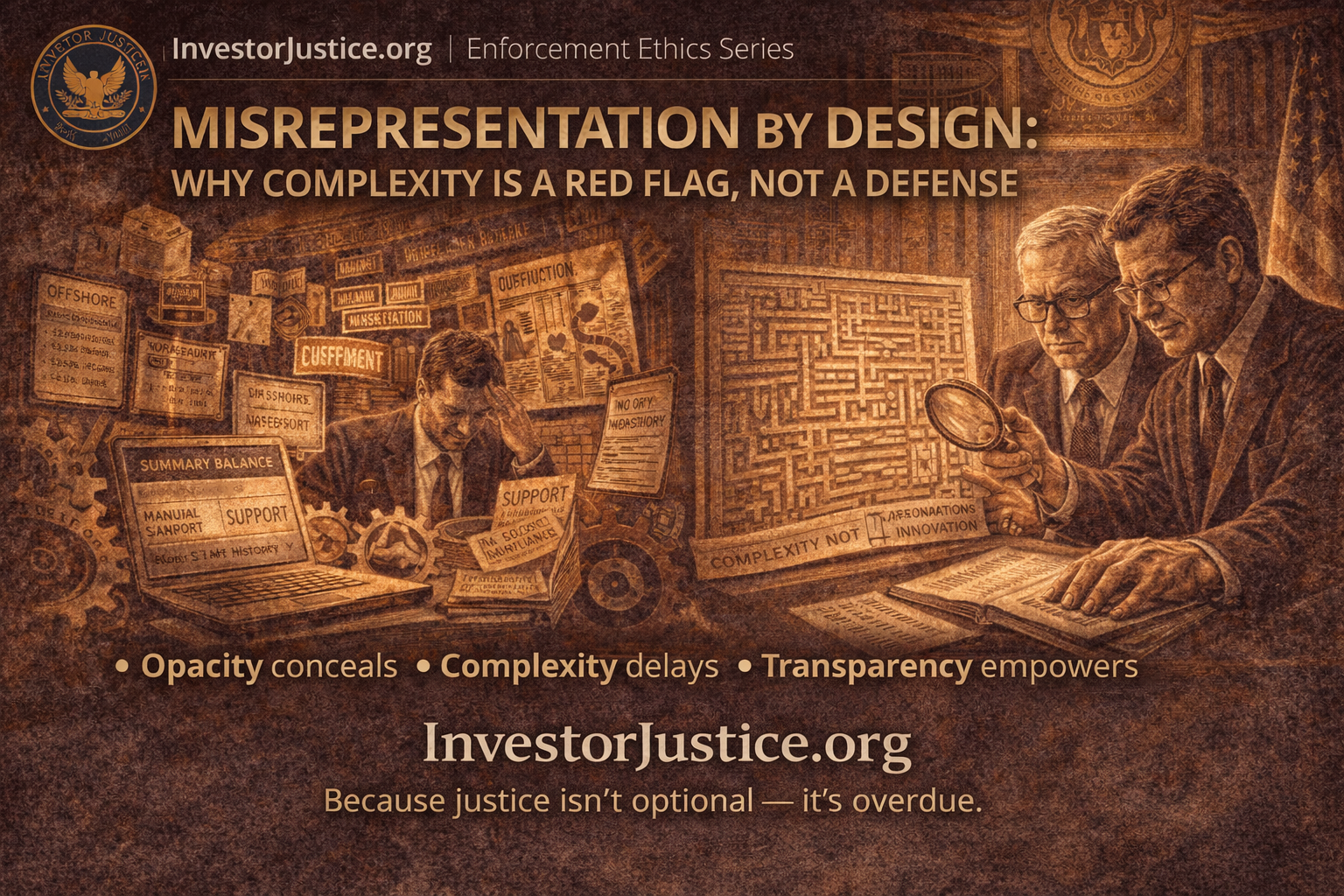
Technology is supposed to illuminate. Yet, too often, it is used to obscure.
The Transparency Paradox
The blockchain revolution began with a promise: “Don’t trust — verify.”
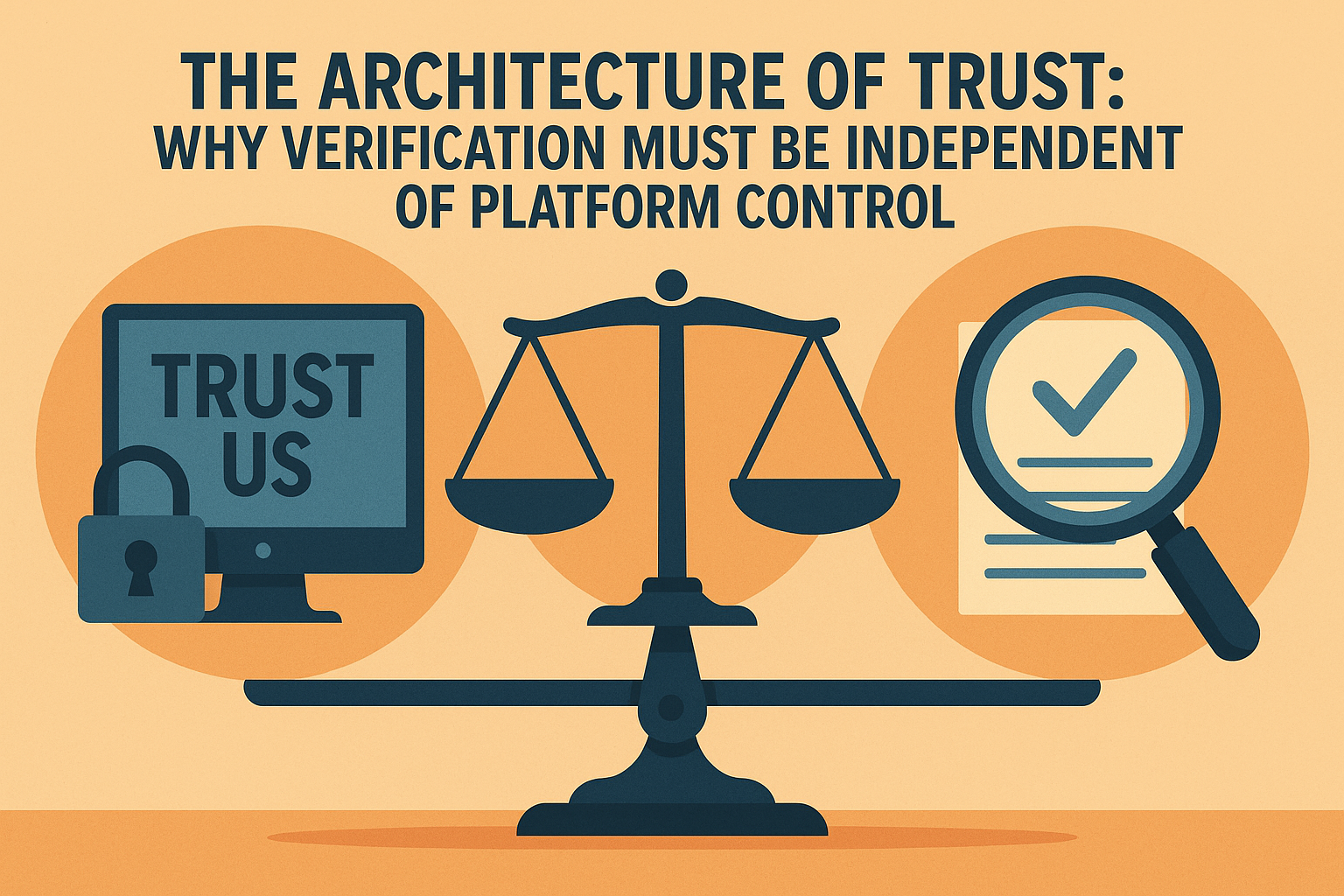
But in practice, most platforms built on top of that technology have turned verification into theater.
- “Proof of reserves” that omit liabilities.
- “Decentralized” protocols run by centralized insiders.
- “Audits” performed by firms paid by the entities they audit.
The irony is profound. The tools for radical transparency exist yet the culture of accountability is missing.
The Public Ledger Concept
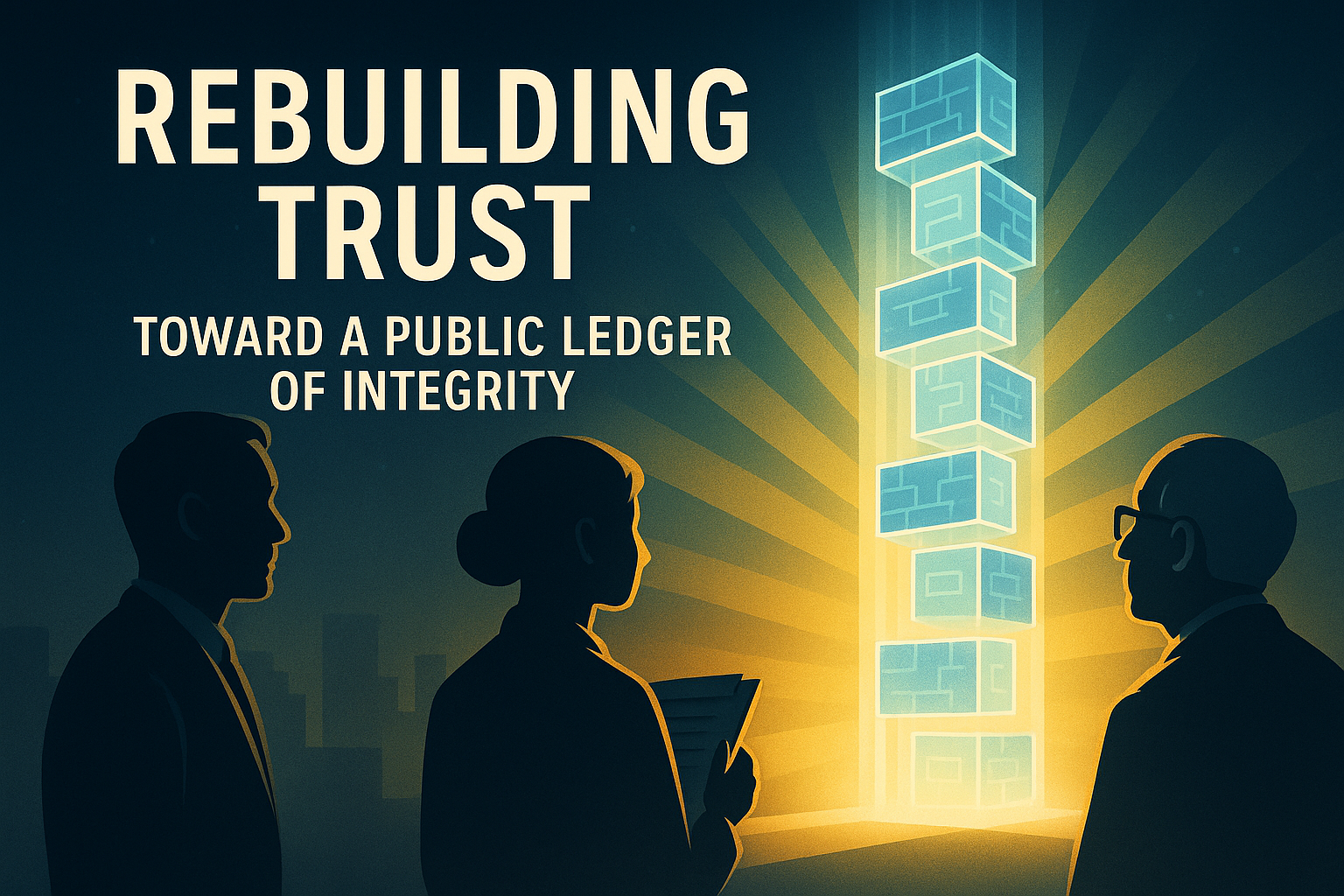
A Public Ledger of Integrity is not another blockchain or financial platform.
It’s a governance layer; an open, regulator-accessible record designed to verify, not speculate.
Imagine a system where:
- Regulators can confirm institutional solvency and reserve integrity in real time.
- Auditors can cross-check claims without corporate gatekeeping.
- Investors can view high-level transparency metrics without exposing personal data.
This is not science fiction.
The underlying architecture, distributed verification, hashed attestations, and open APIs, already exists.
What’s missing is the public mandate to make verification mandatory, not optional.
How the Ledger Would Work
The Public Ledger of Integrity would operate as a neutral trust layer across financial ecosystems.
- Data Entry
- Institutions publish cryptographically signed summaries of key metrics (reserves, liabilities, governance attestations).
- Third-party auditors append verification proofs to those entries.
- Access Control
- Regulators gain privileged API access to underlying data.
- Public users view transparency indicators (audit timestamp, attestation status, jurisdiction compliance).
- Immutable Recordkeeping
- Every change is recorded as a new entry, never overwriting prior data.
- This ensures a permanent accountability trail, not a marketing reset.
- Cross-Jurisdictional Validation
- National and state regulators connect through a unified interoperability framework, allowing independent oversight without data duplication.
The result: a financial ecosystem that is not only open, but verifiably honest.
From Compliance to Confidence
Traditional compliance is retrospective; it asks, “Did you break the rule?”
Integrity-based transparency is continuous; it asks, “Can we see that you’re following the rule right now?”
A Public Ledger of Integrity transforms oversight from investigation into verification.
It empowers regulators to act preventively rather than reactively to identify cracks before collapse.
In short:
Compliance looks backward.
Integrity looks forward.
The Civic Dimension
Financial trust is not just a private contract, it’s a public covenant.
Every time investors are misled or regulators blindsided, civic confidence erodes.
And when citizens lose faith in fairness, democratic stability follows.
Rebuilding financial trust, therefore, is not just a market imperative.
It’s a civic defense strategy.
Transparency isn’t the enemy of innovation.
It is the only way innovation deserves the public’s trust.
The Road Ahead
Rebuilding trust will not come from better branding or new buzzwords.
It will come from verifiable truth, proof of integrity that stands on its own.
To get there, the next steps are clear:
- Legislators must require interoperability standards for financial data access.
- Regulators must demand machine-readable disclosures with cryptographic integrity.
- Platforms must treat transparency not as charity but as license to operate.
- Developers must design for auditability, not opacity.
Because when transparency is embedded in infrastructure, trust is no longer optional, it is automatic.
Closing
The future of finance will not be built on slogans or secrecy.
It will be built on proof, verifiable, immutable, and open to all.
And when that proof becomes public infrastructure, we will finally have what digital finance promised all along:
A system worthy of the trust it asks for.