Table of Contents
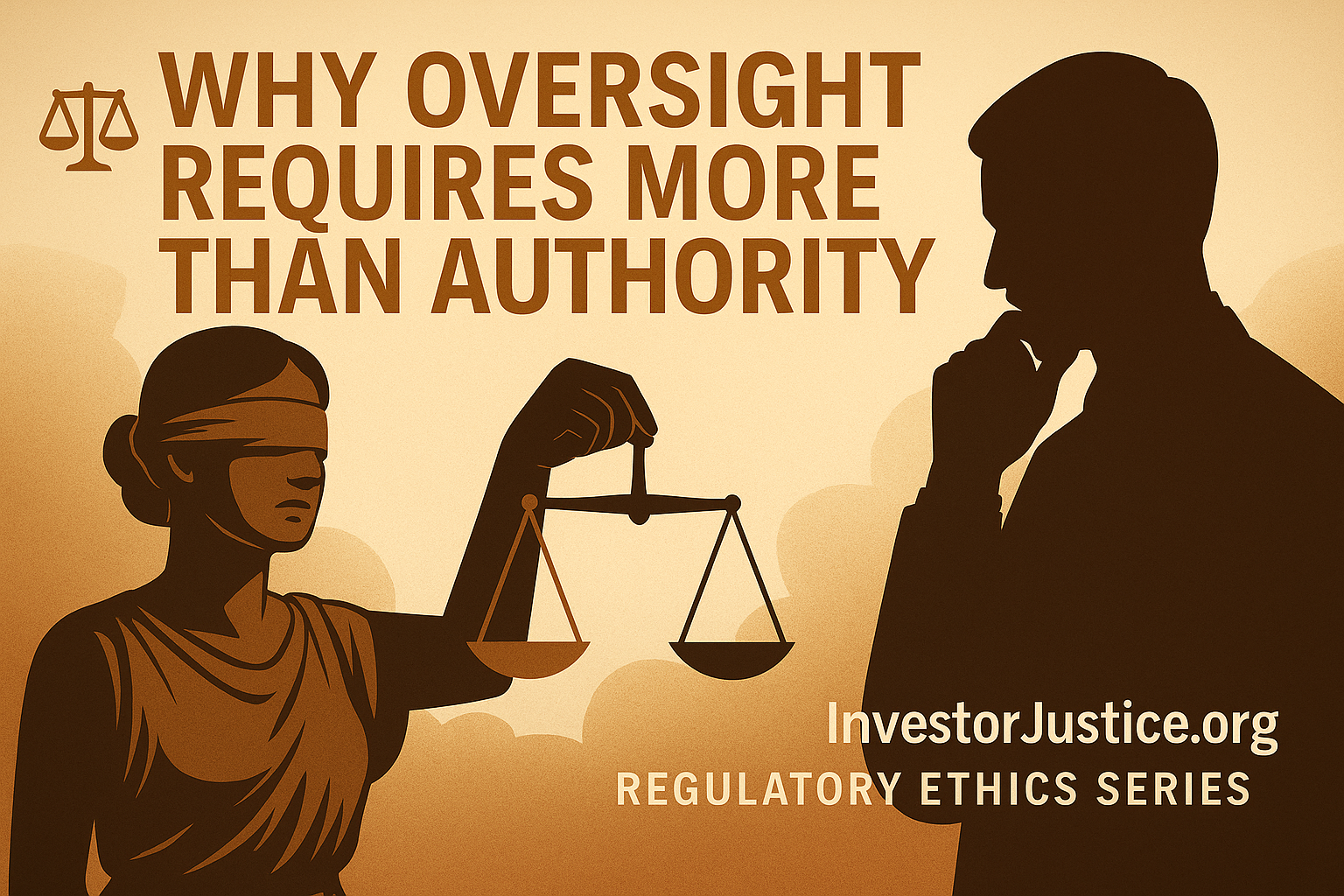
InvestorJustice.org – Regulatory Ethics Series (Intro)
Regulation is not just a matter of statutes, jurisdiction, or enforcement mechanics. It is a human system, shaped by psychology, institutional culture, and the moral weight of decisions that ripple outward into the lives of real people.
The failures that harm investors rarely come from a lack of power.
They come from a lack of will.
Agencies have authority.
Yet authority without courage becomes procedural neutrality.
And procedural neutrality, in the face of active evasion or misconduct, becomes complicity.
Why This Series Exists
Much of the public discussion around financial regulation focuses on the rules:
what they are, whether they apply, and how they should be updated.
But very little attention is given to the regulators themselves:
- How do they think about harm?
- What psychological pressures shape their decisions?
- What happens when risk-aversion outweighs action?
- Why do some agencies intervene early while others wait for collapse?
- And what moral obligations do regulators carry when they are the last protective barrier between citizens and predatory systems?
The Regulatory Ethics Series explores this neglected dimension:
the stewardship responsibilities of oversight agencies and the ethical foundations of protective governance.
A Third Pillar in the Accountability Ecosystem
InvestorJustice.org now rests on three complementary series, each covering a different mode of accountability necessary for a trustworthy financial system:
Systems — The Financial Transparency Series
How visibility, verification, and independent auditability prevent harm before it occurs.
Structures — The Corporate Dynamics Series
How organizations behave under pressure, how they evade responsibility, and how internal incentives shape misconduct.
Stewardship — The Regulatory Ethics Series (this series)
How regulators make decisions, why delays occur, and what ethical duties agencies hold when the public cannot protect itself.
Together, these three pillars answer a single civic question:
What does a fair financial system require from every participant — corporations, technologists, and regulators alike?
Themes This Series Will Explore
Regulatory Psychology
How burnout, normalization of harm, and institutional defensive postures influence outcomes.
Moral Hazard Within Agencies
Why “doing nothing” often feels safer internally than taking decisive action — even when inaction harms the public.
Courage vs. Compliance
When following procedure becomes a shield to avoid responsibility rather than a pathway to accountability.
Delay as Ethical Failure
Why waiting for perfect evidence can be indistinguishable from permitting continued harm.
The Public Consequences of Hesitation
What happens when regulators underestimate the cost of inaction — not in dollars, but in human stability and trust.
Why This Matters Now
Modern financial misconduct moves faster than legacy processes.
Offshore structures, algorithmic trading, opacity-as-a-service platforms, all evolve at speeds that overwhelm bureaucratic caution.
When regulators hesitate, bad actors do not pause out of politeness.
They accelerate.
Regulatory ethics is no longer philosophical.
It is operational.
Oversight without moral clarity leaves citizens unprotected, democratic trust eroded, and markets built on fear rather than fairness.
What This Series Asks
This series asks regulators, and the public, to confront a simple truth:
Power is only meaningful when exercised in defense of those who cannot defend themselves.
Agencies are not only arbiters of rules; they are stewards of civic safety.
Their ethical duty is not neutrality, it is protection.
And where that protection falters, the public deserves to understand why.