Table of Contents
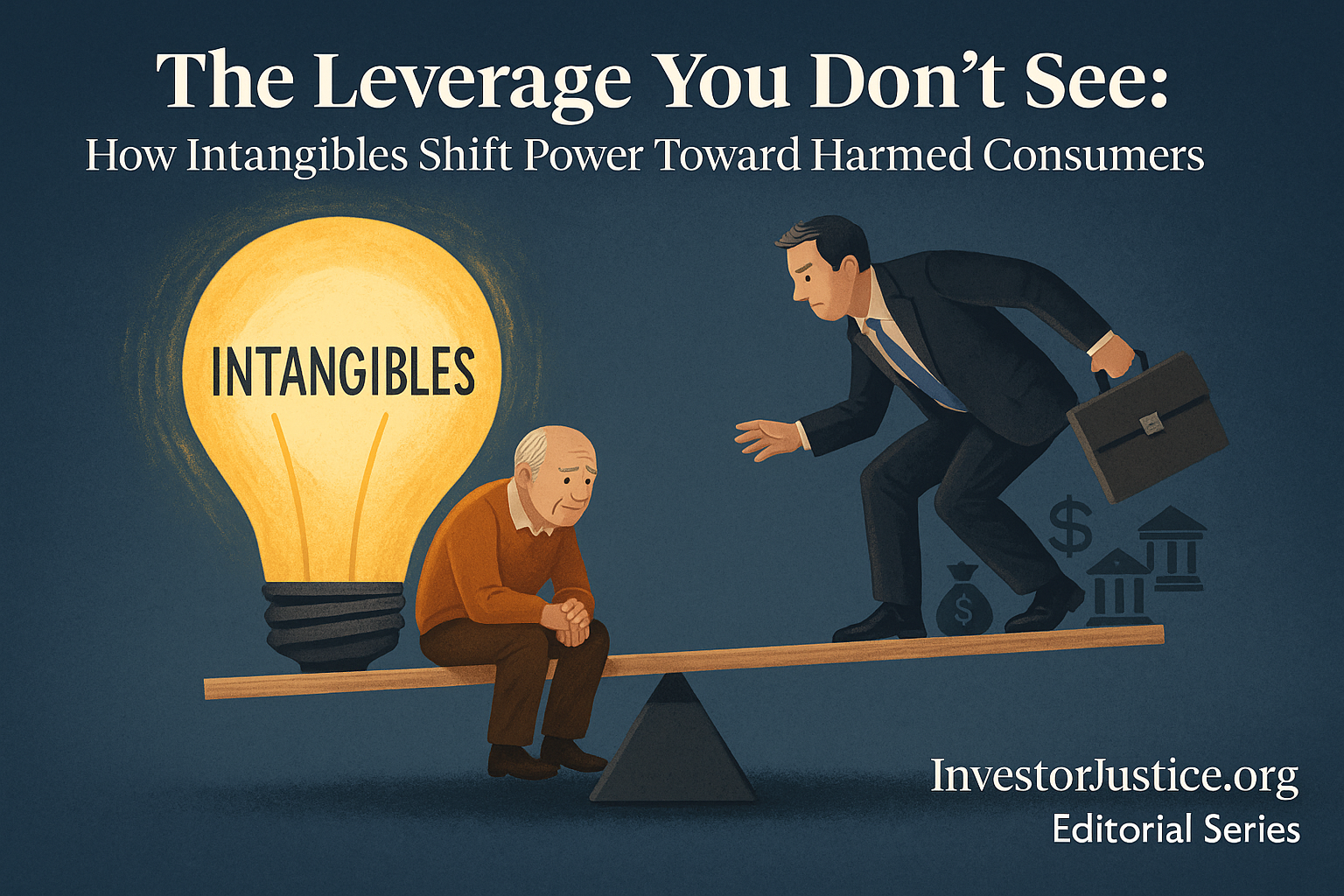
InvestorJustice.org | Editorial Series
In consumer-finance disputes, people often assume the company holds all the power: more lawyers, more money, more time, more jurisdictional tricks.
But when regulators and public-interest institutions enter the picture, something shifts.
A new type of leverage emerges — quiet, invisible, and often far more powerful than anything written in a contract.
We call it intangible leverage.
These are the forces companies cannot buy their way out of, delay indefinitely, or silence through legal disclaimers.
They are structural, reputational, procedural, and psychological.
And when a harmed consumer documents the truth with precision and persistence, these intangibles can outweigh the company’s formal advantages.
Narrative Leverage: The Truth That Holds Its Shape
Companies can argue interpretations, but they cannot rewrite facts.
A well-documented timeline, especially involving:
- misrepresentation,
- refusal to provide records,
- offshore evasion,
- and clear consumer harm
creates a narrative so stable that regulators and journalists rely on it.
This narrative becomes its own form of gravity: it pulls institutions toward action and prevents the company from escaping accountability through ambiguity.
A company can dispute an allegation.
It cannot dispute a pattern.
Regulatory Leverage: Silence Is Not Neutral
When a regulator receives a clear, documented case and fails to act, the regulator inherits the risk.
This creates urgency behind the scenes.
Regulatory bodies do not want:
- precedent that they missed senior harm,
- the appearance of being misled by a company,
- or public scrutiny for ignoring clear evidence.
Intangible leverage arises not from threats, but from the regulator’s own duty.
The stronger the evidence, the less discretion they truly have.
Pattern Leverage: One Case Unlocks Many
Platforms fear cases that expose systemic issues, because one strong example can open:
- class-action exposure,
- regulator coordination,
- precedent across states,
- media narratives,
- and consumer-advocacy attention.
A single well-evidenced claim can become a Rosetta Stone for an entire industry pattern.
Companies understand this.
Regulators understand this.
This is why complete silence is rarely the real posture.
The ignored case becomes the dangerous case.
Reputational Leverage: The Part Companies Cannot Control
Offshore platforms operate on borrowed credibility.
They rely on:
- marketing,
- celebrity partnerships,
- public image,
- and the illusion of safety.
A documented misrepresentation, especially one affecting retirement-age consumers, punches directly through that illusion.
Reputational damage spreads faster than legal damage.
And companies know this.
This creates incentive to resolve strong cases quietly, quickly, and cleanly.
Temporal Leverage: Delay Shifts the Burden Backward
Companies assume delays weaken consumers.
Sometimes they do.
But long delays also:
- increase the regulatory risk,
- expand the reputational risk,
- accumulate procedural failures,
- and draw attention to the company’s refusal to engage.
By the time a regulator reopens a delayed case, the company faces:
- a stronger factual record,
- a more sympathetic victim,
- and a more irritated enforcement team.
Delay, when documented, becomes evidence.
That is leverage.
Integrity Leverage: When One Side Acts Transparently
Regulators, journalists, and public-interest groups take note when a harmed consumer:
- documents everything,
- publishes transparently,
- maintains accuracy,
- avoids speculation,
- acts in good faith,
- and continues despite exhaustion.
This builds credibility and credibility is a currency.
Every institution works harder for the party that exhibits integrity.
No offshore entity can replicate that.
Moral Leverage: The Part Regulators Never Admit Out Loud
Regulators are staffed by human beings.
People who:
- have parents,
- have aging relatives,
- understand vulnerability,
- and know what financial harm does to real lives.
When an older consumer loses savings through misrepresentation or obstruction, the emotional and ethical weight on the regulator is real.
Moral leverage is not loud.
It is not aggressive.
It is not manipulative.
It is the regulator recognizing that doing nothing would be unjust and they do not want to be the reason harmful behavior repeats.
The Takeaway
Intangible leverage is not about threats, pressure, or conflict.
It arises naturally when the truth is clear and the documentation is strong.
It comes from:
- narrative integrity,
- regulatory duty,
- pattern exposure,
- reputational risk,
- and the moral weight of retirement-age harm.
Companies may appear untouchable.
Regulators may appear silent.
But once these forces align, resolution shifts from optional to inevitable.
This is the power most harmed consumers never realize they have until the moment it begins to work.
And when it does, it changes everything.