Table of Contents
InvestorJustice.org | Legal Primer Series
Financial misrepresentation is not always loud.
Sometimes it is subtle, structured, and engineered to look legitimate until the moment harm occurs.
This primer explains exactly how U.S. law treats misleading financial claims, why certain misrepresentations cannot be “cured” by later disclosures, and how the doctrine of scienter applies when platforms change or quietly remove misleading language after-the-fact.
We use APR misuse as a primary example, but the principles apply across all investments.
What Counts as Misrepresentation in Financial Products?
In plain terms:
A misrepresentation occurs when a financial platform makes a statement (or omission) that would mislead a reasonable consumer about the nature, safety, or characteristics of a financial product.
This includes:
- falsely describing risk
- implying protections that do not exist
- labeling a product as something it is not
- understating exposure
- overstating stability or rewards
- presenting incompatible features as compatible (e.g., “APR” + “liquidation-based margin loan”)
Misrepresentation can be:
- Affirmative — an explicit false or misleading claim
- Omission-based — hiding or failing to disclose material facts
- Structural — designing a dashboard or interface that creates false impressions
- Temporal — changing representations after a consumer commits funds
Courts evaluate the reasonable consumer standard, not the platform’s preferred interpretation.
The APR Example: A Case Study in Structural Deception
APR (Annual Percentage Rate) in the U.S. is regulated terminology.
It is defined by:
- predictable amortization
- transparent interest accumulation
- absence of liquidation triggers
- non-volatile collateral assumptions
- standardized disclosure rules
A margin-collateralized liquidation product cannot functionally or legally operate as an APR-bearing credit product.
Thus, when a platform labels a liquidation-based margin loan as “APR,” the law sees a simple truth:
The representation is false the moment the consumer sees it.
No Terms of Service clause can fix that.
No later “clarification” can erase it.
No offshore entity can shield it.
This is the legal foundation of misrepresentation:
Misrepresentation Cannot Be Cured After the Investment
(The “Initial Taint” Doctrine)
Once a consumer enters the transaction based on a false claim, the investment is tainted at inception.
This means:
- removing the misrepresentation later does not undo the harm
- updating the Terms of Service does not cure the deception
- sending a later disclosure does not absolve the platform
In legal terms, the violation is anchored to the initial reliance period.
This is why courts have repeatedly held that:
A later disclaimer cannot erase an earlier lie.
Scienter: Why Changing the Misrepresentation Later Makes It Worse
Scienter means the company knew, or should have known, that the representation was false, and continued anyway.
Scienter is established when:
- the company changes misleading language after complaints
- terms evolve in ways that contradict earlier marketing
- risk descriptions shift only after users are harmed
- internal staff acknowledge the difference between marketing and reality
- the platform refuses to provide historical records
Scienter indicators include:
- removing APR language after liquidations
- adding disclaimers long after harm occurs
- claiming offshore jurisdiction only once regulators arrive
- resisting data production
- blaming consumers for believing the marketing
These are classic scienter signals used by regulators and courts.
Scienter turns a simple violation into:
- fraud (civil)
- deceptive practices (administrative)
- intentional misconduct (punitive exposure)
Why Misrepresentation in Investment Products Is Especially Serious
Financial misrepresentation is more severe than general consumer deception because:
- losses compound
- volatility multiplies harm
- retirees and vulnerable consumers cannot recover
- liquidation events cannot be undone
- platforms intentionally target emotionally stressed or unsophisticated users
A consumer who buys a defective toaster can get a replacement.
A consumer whose life savings evaporate due to misrepresented investment features cannot.
This is why investment misrepresentation triggers:
- enhanced penalties
- regulatory priority
- multi-jurisdiction coordination
- potential criminal exposure when scienter is strong
Where Terms of Service Fit In (And Why They Don’t Protect Wrongdoers)
Companies often lean on Terms of Service to defend themselves.
But under U.S. law:
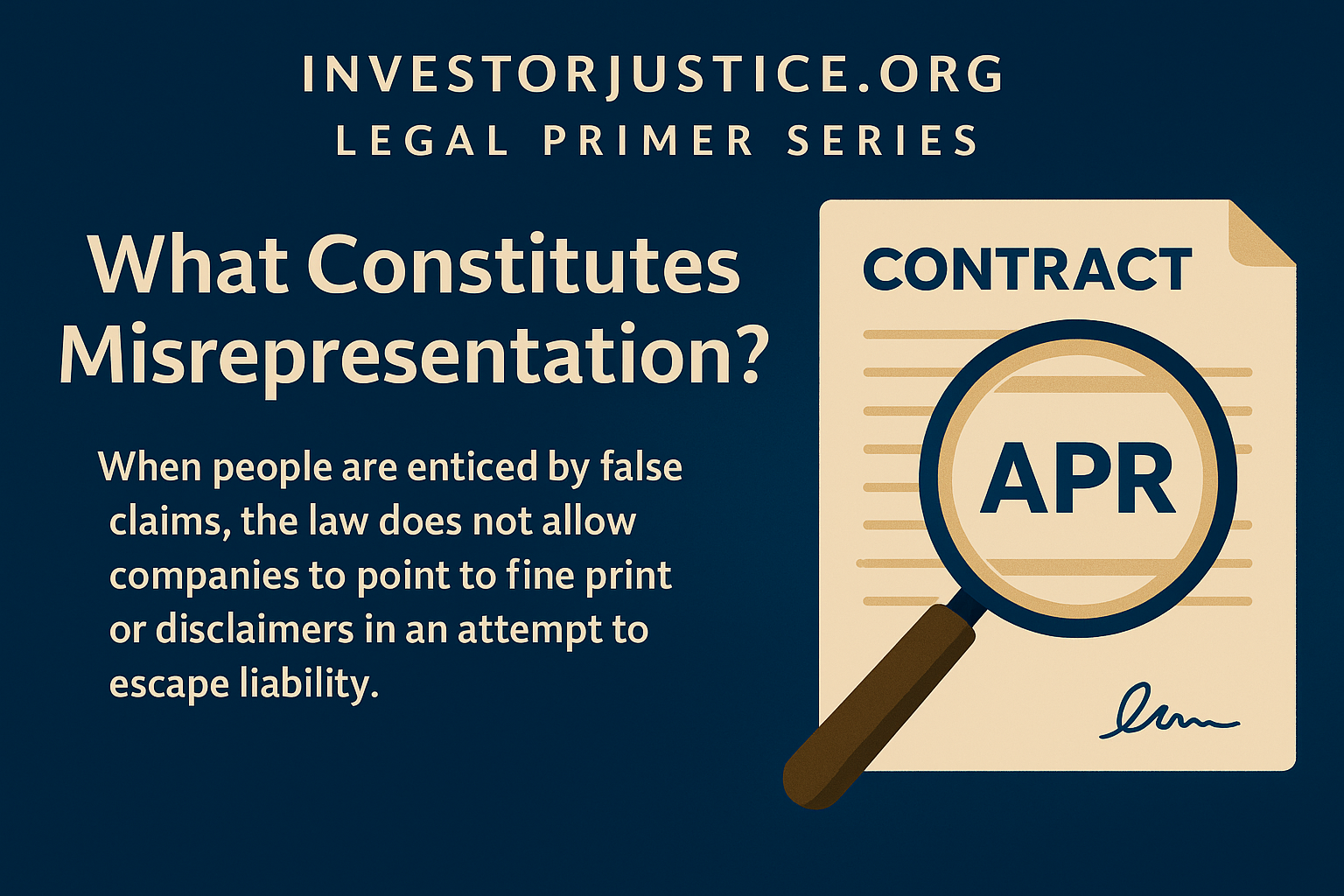
Fine print cannot contradict, override, or nullify false marketing.
Courts interpret ToS through the lens of:
- reasonable expectations doctrine
- unequal bargaining power
- consumer-protection statutes
- unconscionability
If the consumer-facing marketing uses:
- APR
- “guaranteed returns”
- “no liquidation risk”
- “credit line”
- “bank-like lending”
then the ToS cannot secretly convert it into:
- a margin account
- a liquidation-triggered risk pool
- an unregulated derivative
That contradiction is itself evidence of deception.
Why Retirees Are Legally a Special Class
Misrepresentation that harms seniors is treated as aggravated misconduct because retirees:
- rely more heavily on platform representations
- have fewer years to recover
- face greater psychological and medical stress under financial uncertainty
- often cannot parse dense legal disclosures
Many states, including California, explicitly place seniors in a protected vulnerability category for consumer financial harm.
This means:
- lower evidentiary thresholds
- enhanced damages
- accelerated priority
- strict penalties for deceptive practices
When scienter + senior harm combine, regulators treat the case as high severity.
Why Jurisdictional Evasion Strengthens the Misrepresentation Case
Platforms often try to hide behind:
- Cayman entities
- Swiss entities
- Bulgarian operations
- BVI shells
- Maltese affiliates
But U.S. law focuses on:
- where the harm occurred
- where the consumer lives
- where the marketing was targeted
- where the financial rails run
If the platform:
- advertises to U.S. residents,
- accepts U.S. funds,
- uses U.S. wires,
- maintains U.S. customer support,
- or impacts U.S. consumers…
then U.S. jurisdiction applies, regardless of offshore paperwork.
Attempting to evade records production or shift blame is further proof of scienter.
The Takeaway
Misrepresentation is not a technicality. It is a foundational violation.
When a platform:
- advertises a product dishonestly,
- induces investment under false premises,
- changes the story after funds arrive,
- hides behind offshore shells, or
- deletes or refuses to produce account records…
the law interprets this as:
- deception,
- intentional misconduct,
- scienter, and
- heightened liability,
especially when retirees are involved.
The doctrine is simple and powerful:
A lie at the beginning infects everything that follows.
This is why misrepresentation cases, especially with senior harm, deserve regulatory priority and meaningful remedies.