Table of Contents
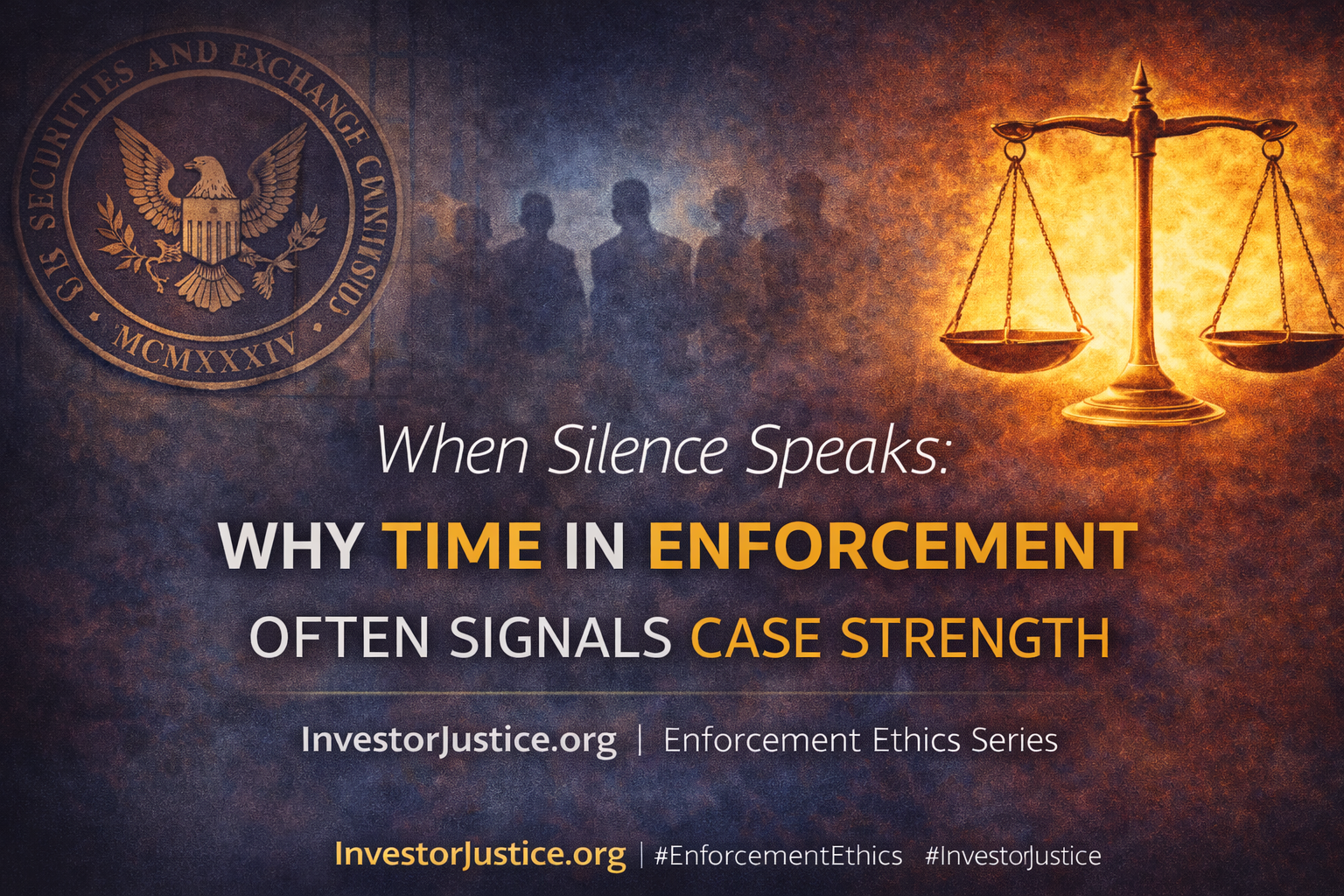
InvestorJustice.org | Enforcement Ethics Series
In regulatory enforcement, time is rarely neutral.
For claimants, especially retirement-age investors, the silence that follows escalation to enforcement can feel like abandonment.
But in reality, the opposite is often true.
The Longer the Silence, the Stronger the Case
When regulators escalate a matter to enforcement and then go quiet, it typically means one of two things:
- The case is weak and quietly closed.
- The case is strong and under pressure.
If you're still hearing nothing weeks or months after escalation, it’s usually not because the case has no merit. It’s because the regulator cannot close it without consequence and because the respondent is resisting resolution behind the scenes.
Why Silence Often Means Strength
1. Weak Cases Are Closed Quickly
If your case lacked substance or failed basic legal thresholds, it would likely be closed with a polite notice and a final determination. Regulators do not spend months sitting on meritless complaints, they move on.
If there’s no closure, it means closure isn’t possible yet and that’s typically because the agency is still in active engagement, likely with the respondent.
2. Delays Reflect Pushback, Not Apathy
When a platform stalls:
- Fails to cooperate fully,
- Refuses to hand over documents,
- Cites offshore structures to avoid scrutiny, or
- Attempts to bargain down the consequences...
The enforcement process slows down.
But that doesn’t mean it stops.
It means the agency is:
- Building leverage,
- Drafting enforcement options,
- Or coordinating cross-agency escalation.
3. Silence Often Reflects Sensitivity
Regulators often go quiet on purpose, especially:
- When negotiations are live,
- When multiple agencies are involved (e.g., DFPI + SEC + foreign regulators),
- Or when they're drafting final findings, penalties, or settlement terms.
No regulator wants to telegraph movement too early and risk:
- Spooking the respondent,
- Damaging interagency coordination,
- Or undermining their own enforcement posture.
What It Means for Claimants
If your case has:
- Been acknowledged and escalated,
- Involves documented harm,
- Has not been closed or dismissed,
- And still shows no public outcome...
That’s not a bad sign.
It’s a sign that your case has weight and cannot be quietly ignored.
Especially if the platform has a history of delay, evasion, or misrepresentation.
The Takeaway
In regulatory enforcement, time is a signal.
When nothing happens publicly, something may be happening privately.
The longer an agency like DFPI stays silent after escalation, the more likely it is that:
- Your claim is strong,
- The respondent is resisting,
- And the agency is navigating the pressure carefully.
Justice may still be quiet but it’s not standing still.
Because enforcement should not be a mystery.