Table of Contents
InvestorJustice.org Editorial – Regulatory Ethics Series
Introduction
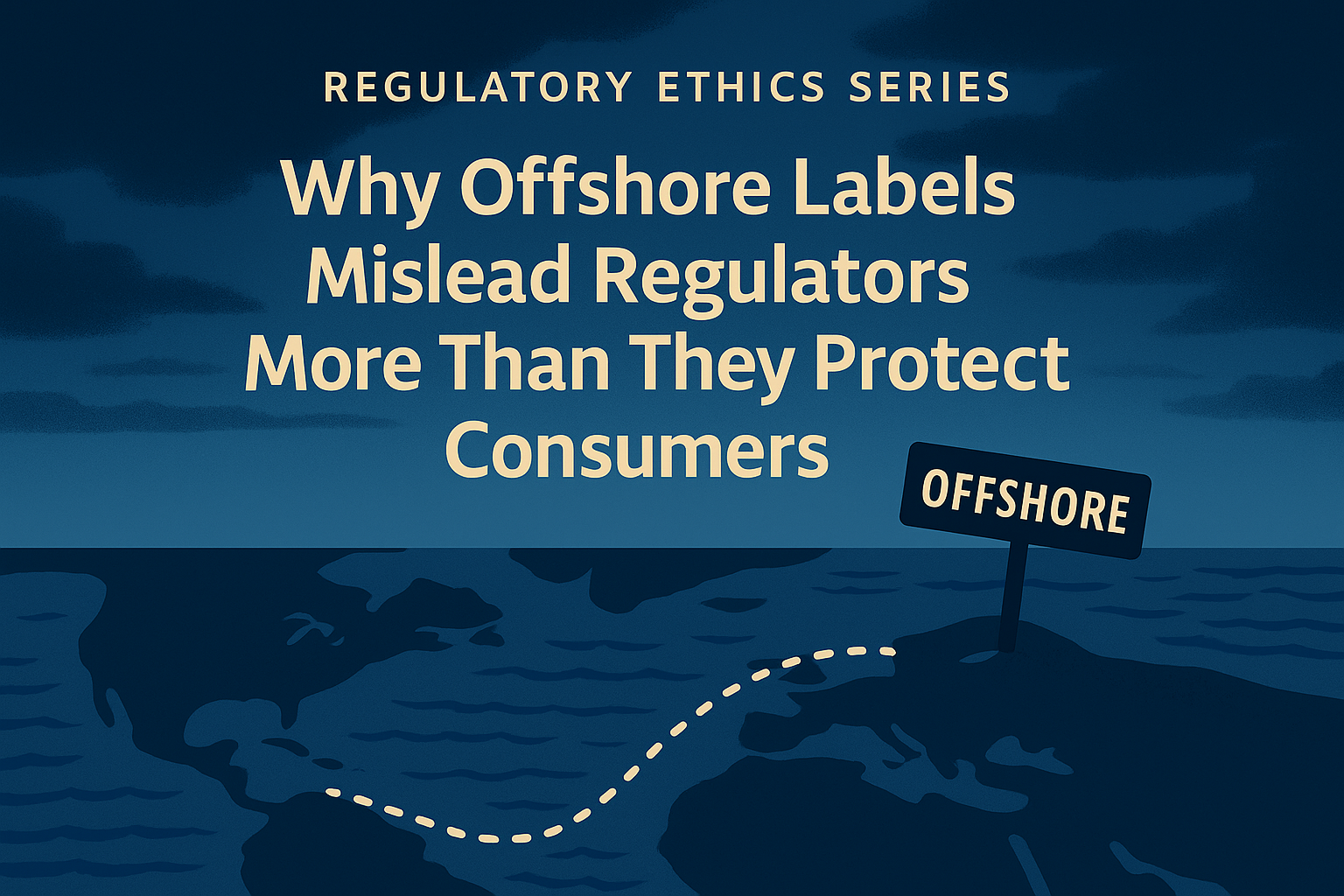
For years, financial platforms have treated offshore incorporation as a shield, an all-purpose defense against accountability, jurisdiction, or consumer protection. Cayman, BVI, Seychelles, Malta, and similar jurisdictions are marketed as “risk-reduction structures,” suggesting that simply placing a company in a faraway registry transforms legal exposure into legal insulation.
But in modern financial oversight, the opposite is increasingly true.
Offshore entities don’t erase liability.
They multiply it by increasing the number of entities involved, the number of regulators alerted, and the number of contradictions a firm must maintain.
And in the eyes of consumer-protection regulators, offshore evasiveness is not neutral, it is a liability amplifier.
This editorial explains why.
Offshore Incorporation Does Not Erase Consumer-Protection Duties
Many platforms believe:
“If we’re incorporated offshore, U.S. consumer-protection laws don’t apply.”
This is incorrect.
Regulators look at:
- where harm occurs,
- where the customer resides,
- and where the business is actually conducted.
If a platform:
- markets to U.S. residents,
- services U.S. residents,
- processes transactions for U.S. residents,
- and profits from U.S. residents,
the offshore address becomes irrelevant.
If you reach into a jurisdiction to take a customer’s money, you bring your obligations with you.
Offshore Structures Trigger Heightened Scrutiny, Not Exemption
Offshore entities correlate with:
- hidden ownership,
- opaque financial practices,
- unregulated leverage,
- incomplete disclosures,
- and difficulty providing records.
Regulators treat these as risk indicators, not logistical quirks.
Jurisdictional evasion signals:
“This entity is structured to avoid transparency.”
Once that signal appears, regulators apply:
- higher scrutiny,
- stronger enforcement posture,
- and lower tolerance for delay or contradiction.
Offshore incorporation is not a shield, it’s a spotlight.
Offshore Contradictions Become Evidence
When a company routes activity through multiple shells, Cayman parent, Swiss subsidiary, Liechtenstein operations, the result is a forest of conflicting statements.
Regulators interpret these contradictions as:
- obstruction,
- jurisdictional confusion as strategy,
- or attempts to avoid accountability.
Example pattern:
- Entity A claims a customer “has no account.”
- Entity B previously responded to regulators about that same account.
Contradictions do not protect a platform.
They incriminate it.
U.S. State Regulators Can Act Even When Federal Agencies Pause
Many offshore platforms assume:
“If the SEC isn’t involved, we’re untouchable.”
Wrong.
State regulators, especially DFPI, can:
- demand restitution,
- issue cease-and-desists,
- suspend market access,
- and coordinate with foreign regulators.
Offshore status does not prevent:
- market bans,
- asset freezes,
- enforcement referrals,
- or cross-border cooperation.
Offshore structures accelerate this coordination, not deter it.
Offshore = Inferred Intent
Regulators don’t just examine what a company is, they examine why it is structured that way.
Questions regulators ask:
- Why hide incorporation offshore if the operations are elsewhere?
- Why route consumer complaints through multiple mismatched entities?
- Why separate legal responsibility from operational staff?
- Why withhold data unless the structure was designed for evasion?
The more the structure resembles an accountability maze, the more regulators infer intent to evade.
Intent amplifies liability.
Withholding Consumer Data Is Treated as Misconduct—Offshore or Not
A core principle in enforcement:
Withholding customer records signals wrongdoing.
Jurisdiction is irrelevant if a platform refuses:
- account history,
- liquidation logs,
- transaction trails,
- collateral records,
- or custody documentation.
Offshore location does not excuse missing data.
It strengthens the case that the data was never legitimate or cannot withstand review.
In the Court of Public Opinion, Evasion = Admission
Even before regulators act, the public applies a simple heuristic:
If a platform could prove innocence, it would.
If it doesn’t, it can’t.
Opaque liquidation processes, entity shell games, or jurisdictional runaround create the appearance of guilt because they functionally mirror it.
Offshore evasion collapses trust far faster than any negative headline.
Conclusion: Offshore Structures Don’t Reduce Exposure — They Multiply It
Firms assume offshore incorporation buys:
- distance,
- insulation,
- or plausible deniability.
But in practice, it:
- triggers more regulators,
- creates more contradictions,
- signals higher risk,
- and erodes credibility.
Jurisdictional evasion is not a loophole.
It is a liability engine.
In the transparency era, where InvestorJustice.org, regulators, reporters, and whistleblowers operate in parallel, evasion no longer protects platforms.
It guarantees accountability.