Table of Contents
InvestorJustice.org | Regulatory Ethics Series
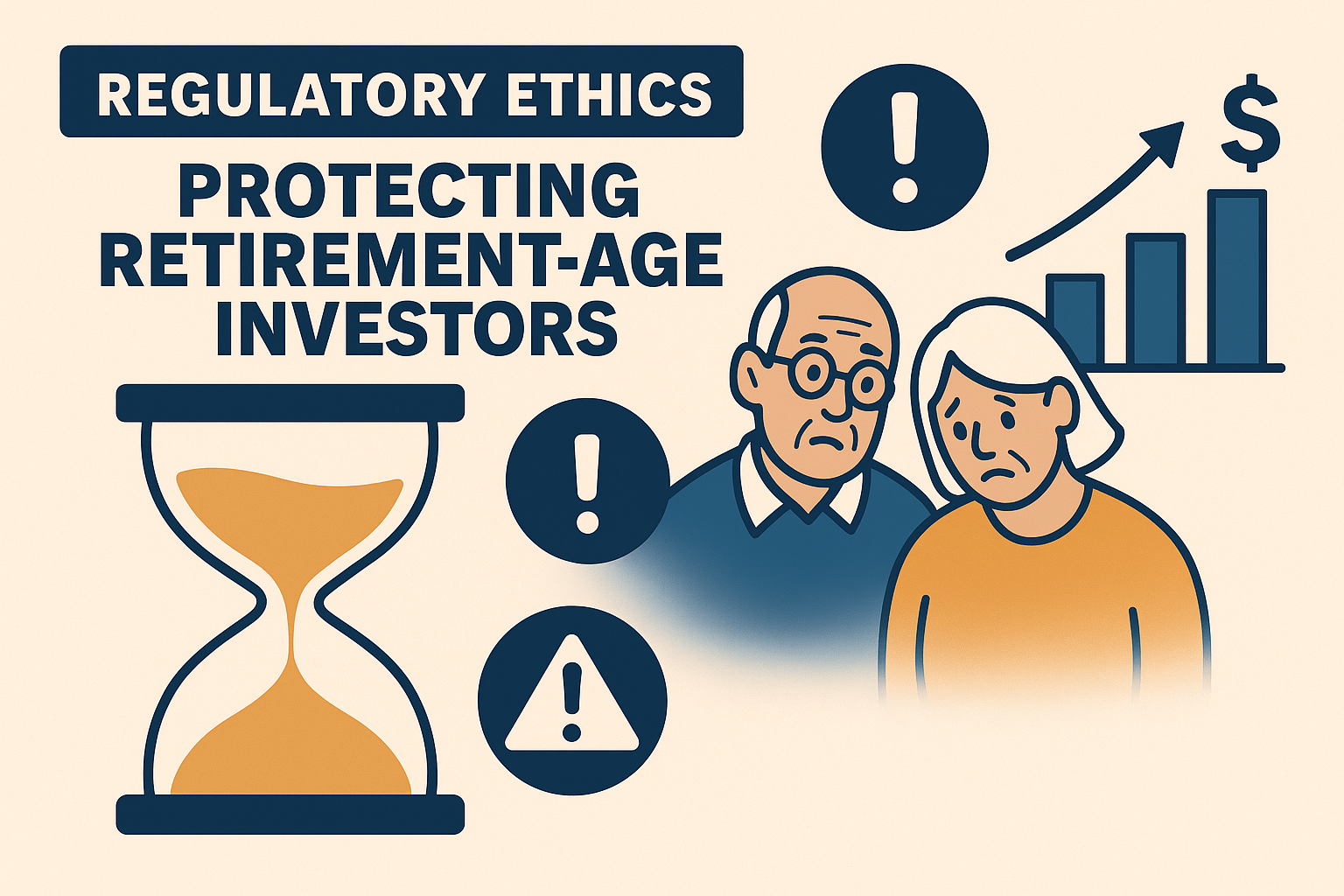
Retirement-age investors carry the highest risk and the lowest margin for recovery.
Yet regulators routinely fail them.
Unlike younger consumers, retirees experience harm on a compressing timeline: they have less time left on earth, less time to recover financially, and far less capacity to rebuild savings after loss.
Ironically, in many jurisdictions where offshore evasion is most rampant, retirement-age individuals are legally recognized as a protected class yet that protection rarely informs regulatory urgency.
The System Assumes Time. Retirees Don’t Have Time.
Regulatory timelines are measured in:
- months
- quarters
- years
But retirees cannot wait that long.
For them, delay is not neutral, it is harm.
Every day a case sits untouched:
- losses compound
- financial insecurity deepens
- emotional stress worsens
- the window for meaningful recovery narrows
A 30-year-old can rebuild.
A 70-year-old often cannot.
Agencies Treat All Consumers as Equal But They Aren’t
Retirement-age individuals face:
- fixed income
- limited or no earning capacity
- heightened susceptibility to misrepresentation
- cognitive vulnerability
- reduced access to technical or legal resources
Regulators often apply the same pace, scrutiny, and escalation guidelines to all consumers.
That is inequity disguised as neutrality.
Real protection requires recognizing that age is a material risk factor not a demographic footnote.
Offshore Platforms Intentionally Target Older Americans
Platforms promoting high-yield or “guaranteed” returns disproportionately target:
- retirees
- pre-retirees
- workers approaching fixed income
Why?
Because these individuals:
- are anxious about outliving savings
- are seeking stability, not speculation
- are more trusting of financial “experts”
- often lack the technical knowledge to spot structural deception
This makes them ideal targets for opaque offshore schemes chasing U.S. capital.
Regulators Rarely Incorporate Age Into Risk Prioritization
Cases involving older victims should trigger:
- higher urgency
- stricter scrutiny
- faster timelines
- mandatory escalations
- earlier intervention
Instead, these cases are processed like every other file even though the consequences are not remotely comparable.
A two-year delay for a retiree is not a procedural inconvenience.
It’s a life-altering loss.
The Takeaway
Protecting retirees requires rethinking what “consumer harm” really means.
Harm is not only measured in dollars.
Harm is also measured in time lost.
For retirement-age investors:
- time is limited
- recovery windows are narrow
- and regulatory delay is indistinguishable from abandonment
If regulators want to protect the most vulnerable consumers, they must redesign their systems around the people who cannot afford to wait.
Retirees are not just another category of complainant.
They are a protected class whose lives can be permanently damaged by silence, delay, and inaction.