Table of Contents
InvestorJustice.org | Regulatory Ethics Series
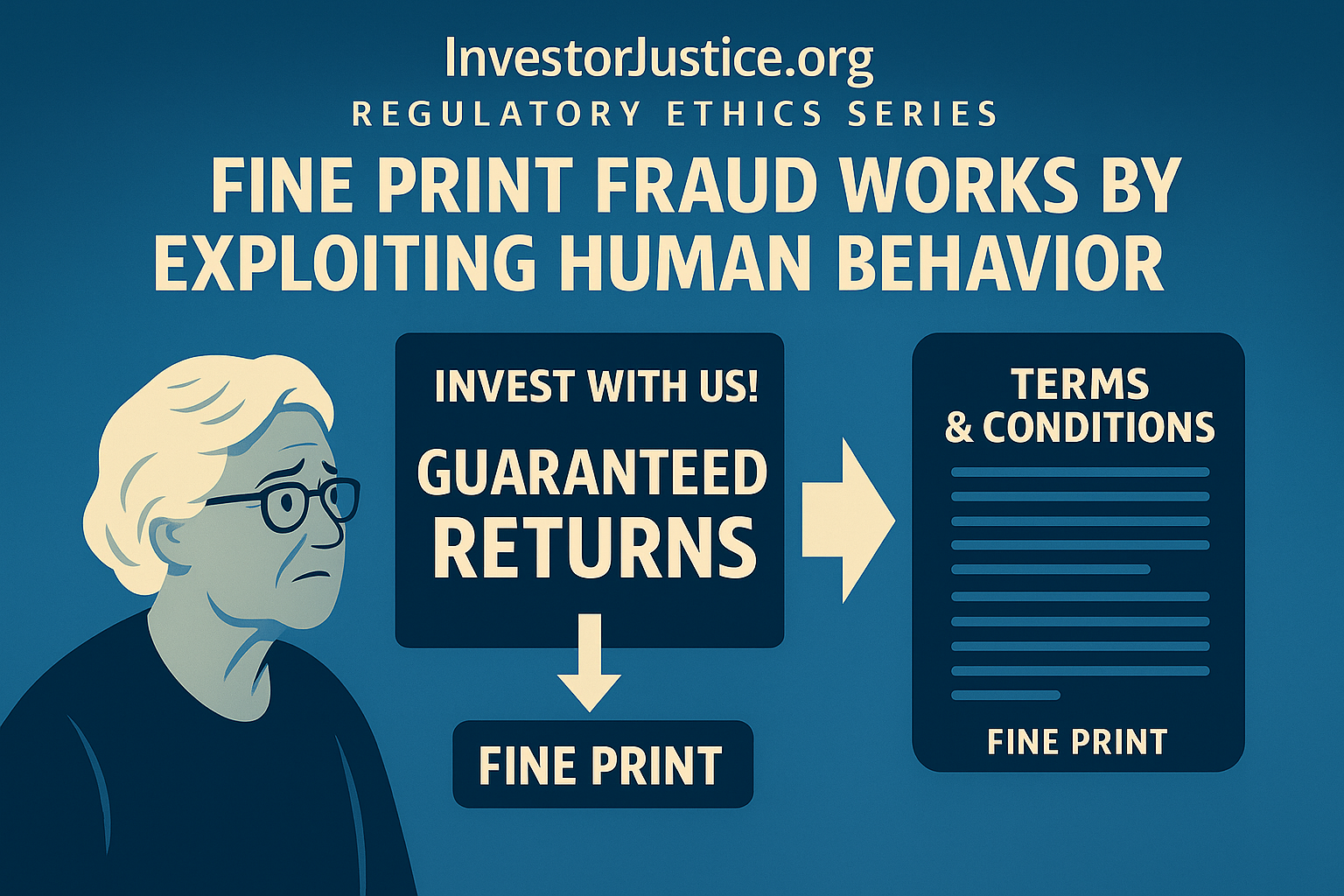
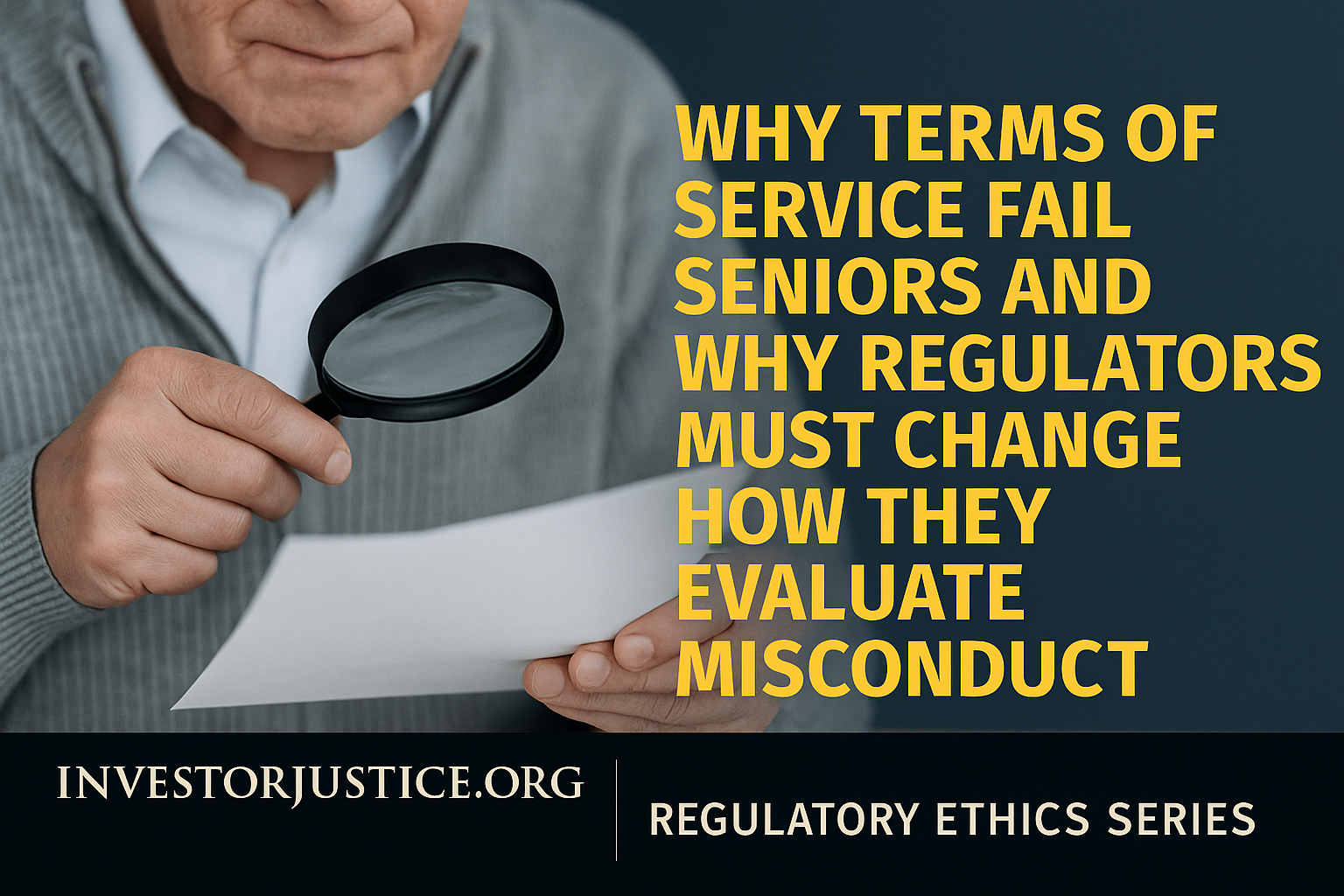
Every day, older Americans rely on digital financial platforms that present themselves as safe, regulated, and trustworthy. And every day, those same platforms hide critical disclosures deep inside Terms of Service documents that most retirees cannot reasonably read, parse, or interpret.
This creates a structural vulnerability:
Regulators evaluate the fine print, but seniors rely on the marketing.
The result is systemic harm.
Retirees Cannot Navigate Complex Legal Disclosures
Retirement-age consumers face unique challenges:
- cognitive fatigue
- reduced processing speed
- chronic stress from fixed-income limitations
- difficulty parsing dense legal texts
- reliance on platform reputation and clarity
Yet the regulatory system still assumes:
That all consumers are equally able to interpret complex ToS language.
This assumption is wrong and harmful.
It creates a situation where platforms can mislead seniors publicly and defend themselves privately using fine print seniors cannot possibly engage with.
The Law Does Not Expect Seniors to Act Like Lawyers
Consumer protection jurisprudence has long recognized a key principle:
The “reasonable consumer” includes vulnerable populations.
The law never intended:
- 72-year-old investors,
- individuals on fixed incomes,
- people navigating medical or cognitive decline
to interpret:
- multi-jurisdictional disclaimers,
- offshore arbitration rules,
- or complex risk disclosures buried in appendices.
When seniors are involved, regulators must apply heightened scrutiny, not neutral scrutiny.
Platforms Exploit Senior Trust More Aggressively
Predatory financial actors know exactly who is most susceptible to:
- unrealistic APR claims,
- guaranteed-yield promises,
- “no-risk” marketing,
- and urgency-driven dashboards.
They target retirees because:
- they have accumulated savings,
- they need income stability,
- they trust official-looking platforms,
- and they have fewer working years left to recover losses.
This is why senior harm must be treated not just as harm but as aggravated harm.
Terms of Service Let Companies Pretend Seniors Were “Informed”
When misconduct occurs, platforms often defend themselves by pointing to:
- risk warnings,
- disclaimers,
- arbitration clauses,
- or multi-page documents “accepted” with a click.
But senior consumers do not, and realistically cannot, meaningfully evaluate these documents.
Regulators must acknowledge:
Apparent consent is not meaningful consent when the complexity is engineered to exceed the consumer’s capabilities.
This is especially true for older consumers.
Regulators Must Adjust Their Frameworks for Senior Protection
Agencies need to modernize their approach.
When a case involves retirees, regulators should:
- accelerate timelines
- impose enhanced documentation requirements
- treat offshore evasion as an aggravating factor
- evaluate the marketing, not just the contracts
- shift the presumption toward consumer protection
Most critically:
Senior harm is not an administrative issue — it is an emergency issue.
Time lost is money lost.
And time is the one thing retirees do not have.
The Takeaway
Terms of Service are structurally incompatible with senior protection.
They shift responsibility onto retirees who cannot reasonably defend themselves against complex legal machinery.
Regulators must stop treating ToS as neutral disclosures and start recognizing them for what they are in cases involving older consumers: barriers to understanding, designed to enable misconduct and limit accountability.