Table of Contents
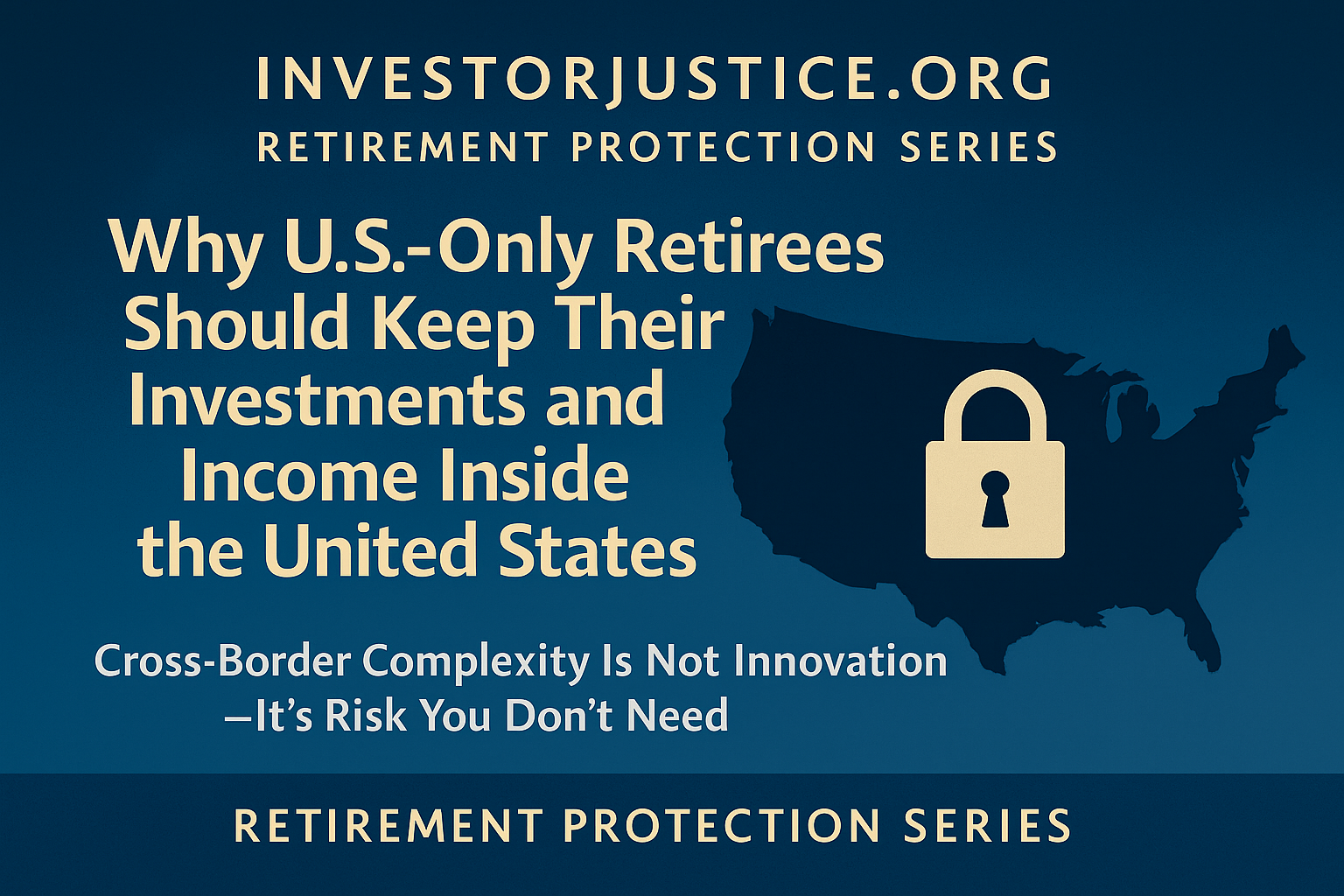
InvestorJustice.org | Retirement Protection Series
Retirement is supposed to be the stage of life where financial decisions become simpler, not more complicated. Yet a growing number of fintech platforms, offshore lenders, and foreign investment services aggressively target American retirees with promises of high yield, global diversification, and sophisticated financial engineering.
For most U.S.-only retirees, this is a trap, not a strategy.
But you assume extraordinary risk.
Even dual citizens must be cautious.
And if you have no foreign residency or legal status, the risk often becomes catastrophic.
This guide explains why.
Retirement Requires Fewer Variables, Not More
Retirees need:
- stability
- clarity
- predictable cash flow
- reliable legal protections
- consistent regulatory oversight
Every additional variable, foreign courts, foreign regulators, foreign insolvency rules compounds risk in ways most retirees cannot anticipate.
In retirement, complexity is not diversification.
It is unnecessary exposure.
Retirees already manage:
- Social Security
- Medicare
- RMDs
- tax planning
- estate administration
- fixed income allocation
Adding foreign jurisdictional complexity is not just unwise, it is structurally dangerous.
Foreign Sovereign Jurisdictions Are Not Designed to Protect U.S. Retirees
Offshore or cross-border platforms operate under frameworks that differ radically from U.S. norms:
- different consumer protection laws
- different definitions of fraud
- different standards for recordkeeping
- different disclosure rules
- different enforcement priorities
- different timelines
No U.S.-based retiree should assume foreign authorities will:
- protect them,
- prioritize them,
- or even recognize their standing.
Foreign regulators are not accountable to you.
Foreign legal systems do not exist for your benefit.
If You Are Not a Citizen, You Are Not a Priority
A sovereign nation’s first obligations are to:
- its citizens
- its domestic banks and pension systems
- its financial stability
- its internal markets
- its politics
U.S. retirees fall into none of these categories.
This is not malicious.
It is structural reality.
If you are an American using a foreign financial platform, you are voluntarily placing your life savings under a legal system that has no duty to protect you.
Even Dual Citizens Must Be Cautious
Dual citizenship can help with:
- local standing
- access to courts
- domestic legal recognition
But the question remains:
Is the foreign jurisdiction as strong, transparent, and protective as the United States?
Many countries lack:
- robust consumer protection
- punitive damages
- class-action structures
- strict recordkeeping requirements
- deep regulatory budgets
- effective financial supervision
If a jurisdiction offers weaker tools to protect you, why choose it for retirement assets?
Dual citizenship does not convert a weaker legal system into a safe one.
Offshore Platforms Exploit the Seniors Least Equipped to Fight Back
Retirement-age Americans are uniquely vulnerable:
- cognitive load increases
- fine print becomes harder to parse
- jurisdictional disclaimers become meaningless
- reliance on trust and reputation increases
- medical and emotional stress compounds
- time to recover losses is limited
Offshore platforms know this.
Their marketing targets retirees precisely because they are:
- trusting,
- capital-rich,
- time-poor,
- and less able to litigate across borders.
When harm occurs, offshore platforms weaponize foreignness as a shield:
- “Your account was under our Cayman entity.”
- “Our Swiss division must handle this.”
- “We have no record of you here.”
This is not a coincidence.
It is a strategy.
Cross-Border Enforcement Is Not Built for Retirees
This is the part no one tells retirees until it is too late.
1. You cannot easily sue a foreign company.
Foreign courts may reject cases outright.
Service of process takes months.
Corporate structures are designed to evade accountability.
2. Regulators cannot easily compel foreign entities.
Offshore shells can ignore U.S. inquiries indefinitely.
Jurisdictional fights delay everything.
Evidence disappears during “system upgrades.”
3. Records vanish, sometimes permanently.
Offshore platforms often do not store:
- liquidation pathways
- transaction-level logs
- price ticks
- audit trails
- exchange execution proofs
When records vanish, retirees lose their case before it even starts.
The United States Has One of the World’s Strongest Consumer-Protection Systems
Despite imperfections, the U.S. provides:
- state-level enforcement (DFPI, NYDFS, etc.)
- federal oversight (SEC, CFTC, CFPB, FTC)
- punitive damages
- class actions
- discovery rights
- recordkeeping laws
- whistleblower protections
- transparent court systems
Offshore jurisdictions typically provide none of these safeguards.
Leaving the U.S. consumer protection ecosystem in retirement is voluntarily stepping off a cliff.
A Simple Rule for U.S.-Only Retirees
There is no meaningful benefit.
But the risk is immense.
You gain nothing by downgrading your legal safety net.
The Takeaway
Retirement is not the time to test offshore systems.
It is not the time to experiment with multi-sovereign complexity.
It is not the time to rely on foreign regulators who have no obligation to protect you.
It is the time to:
- preserve stability,
- minimize complexity,
- eliminate jurisdictional risk,
- and rely on the strongest consumer protections available.
For U.S.-only retirees, that means: