Table of Contents
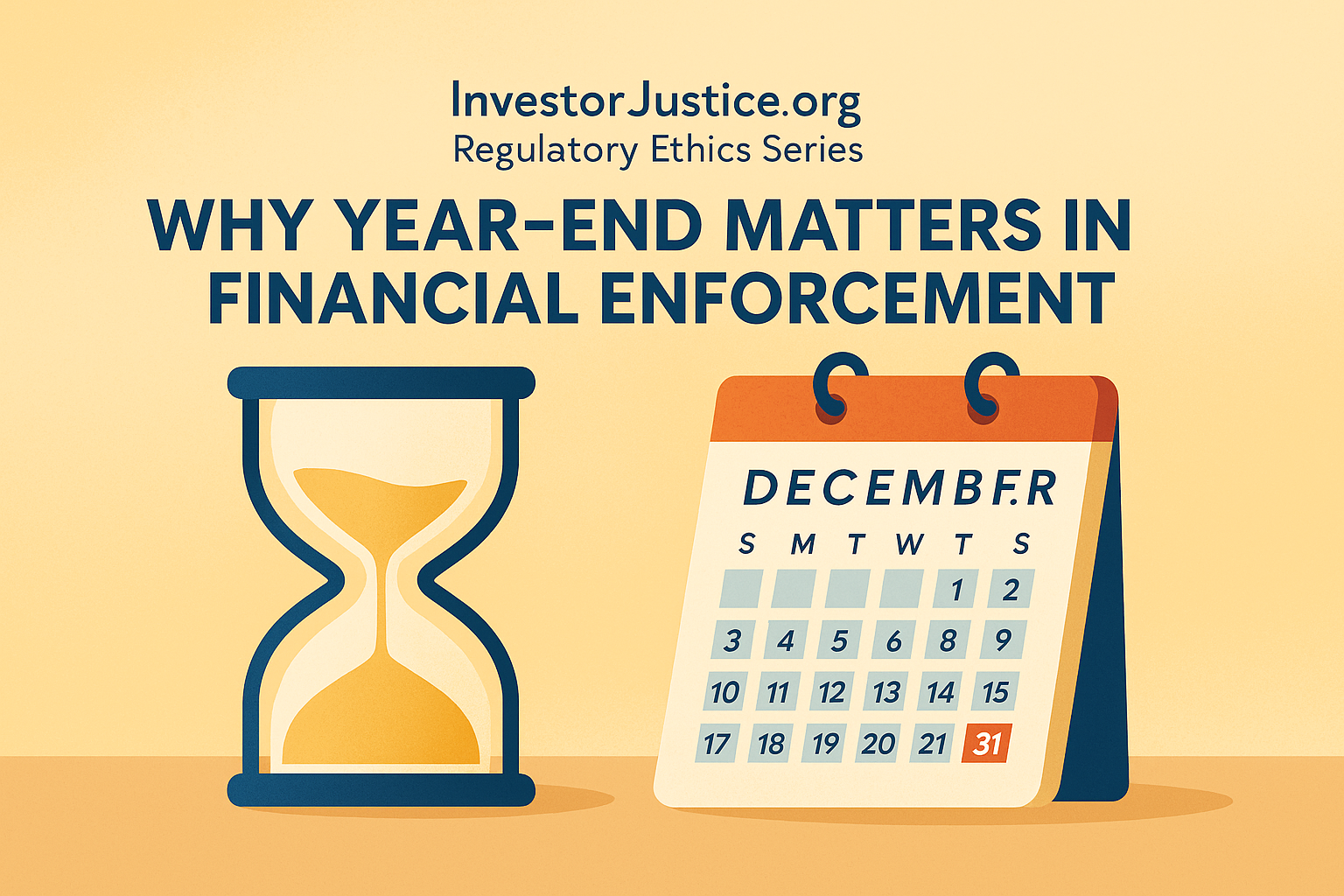
InvestorJustice.org | Regulatory Ethics Series
Most consumers assume financial enforcement is linear: a complaint goes in, investigators work the case, and results arrive whenever they arrive.
But inside regulatory agencies, timing matters.
And few moments shape outcomes more than the final six weeks of the calendar year.
This article explains why, without speculating about any specific agency or case, so consumers and advocates understand the structural forces that influence enforcement timelines.
Year-End Deadlines Shape Agency Behavior
Every regulator, whether state or federal, operates within:
- annual reporting cycles,
- performance metrics,
- budget justifications,
- legislative oversight reviews.
This means the period from mid-November through December often becomes a window where agencies:
- finalize open matters,
- close files for reporting,
- complete enforcement actions to meet yearly benchmarks,
- avoid carrying complex cases into the next fiscal cycle.
This is not a flaw, it is how government accounting works.
Consumer Cases Compete With Systemic Cases
Within agencies, staff must allocate limited resources among:
- large multistate actions,
- industry-wide sweeps,
- systemic market threats,
- and high-impact individual cases.
Year-end creates natural triage.
Cases that are well-documented, cleanly framed, and ready for action typically rise in priority because they can be completed before rollover.
This is why clear, well-organized consumer submissions matter so much.
Vulnerable-Population Cases Become Easier to Prioritize
Retirement-age victims, disabled consumers, and individuals facing imminent financial harm are treated as elevated-urgency categories in most regulatory frameworks.
At year-end, this effect becomes stronger because:
- delayed resolutions compound harm,
- budget cycles may allow accelerated resource allocation,
- and unresolved cases involving vulnerable consumers appear negatively in end-of-year reviews.
Agencies do not need new statutes to prioritize these cases.
They only need to apply discretion they already possess.
Year-End Inaction Carries Risks Too
Regulators rarely discuss this publicly, but in practice:
- delayed action may allow evidence to degrade,
- companies may restructure or move assets,
- offshore shells may become harder to penetrate in a new fiscal cycle,
- and consumers face irreversible harm while waiting.
This creates a structural incentive to act before December rolls over, when internal calendars reset and new priorities compete for space.
Agencies Plan Ahead Even When Consumers See Silence
A lack of visible communication does not mean inactivity.
Regulatory work is often:
- confidential,
- document-intensive,
- coordinated across agencies,
- or in the “pre-demand” phase where silence is required.
The public sees the announcement.
Regulators see the hundreds of hours of work that led to it.
Understanding this gap prevents unnecessary panic and allows consumers to appreciate the workload agencies manage.
The Consumer Takeaway
From the outside, enforcement looks like a black box.
Inside agencies, year-end is one of the most important periods because it forces:
- prioritization,
- triage,
- and resolution.
Consumers should know:
Submitting clear records, updating timelines, and documenting ongoing harm increases the chance a case is prioritized before year-end — without needing to pressure regulators directly.
This is the healthy way the system is supposed to function.
Final Thought
When regulators close a year by resolving well-supported consumer cases, especially those involving retirees, data-withholding, or offshore evasion, they strengthen:
- market trust,
- public accountability,
- and the integrity of the financial ecosystem.
Year-end is more than a date on a calendar.
It is an opportunity to protect the people who need it most.
Investor protection is a year-round responsibility.
Year-end simply makes that responsibility clearer.